
-

Photo: eSeL.at, Robert Puteanu
-
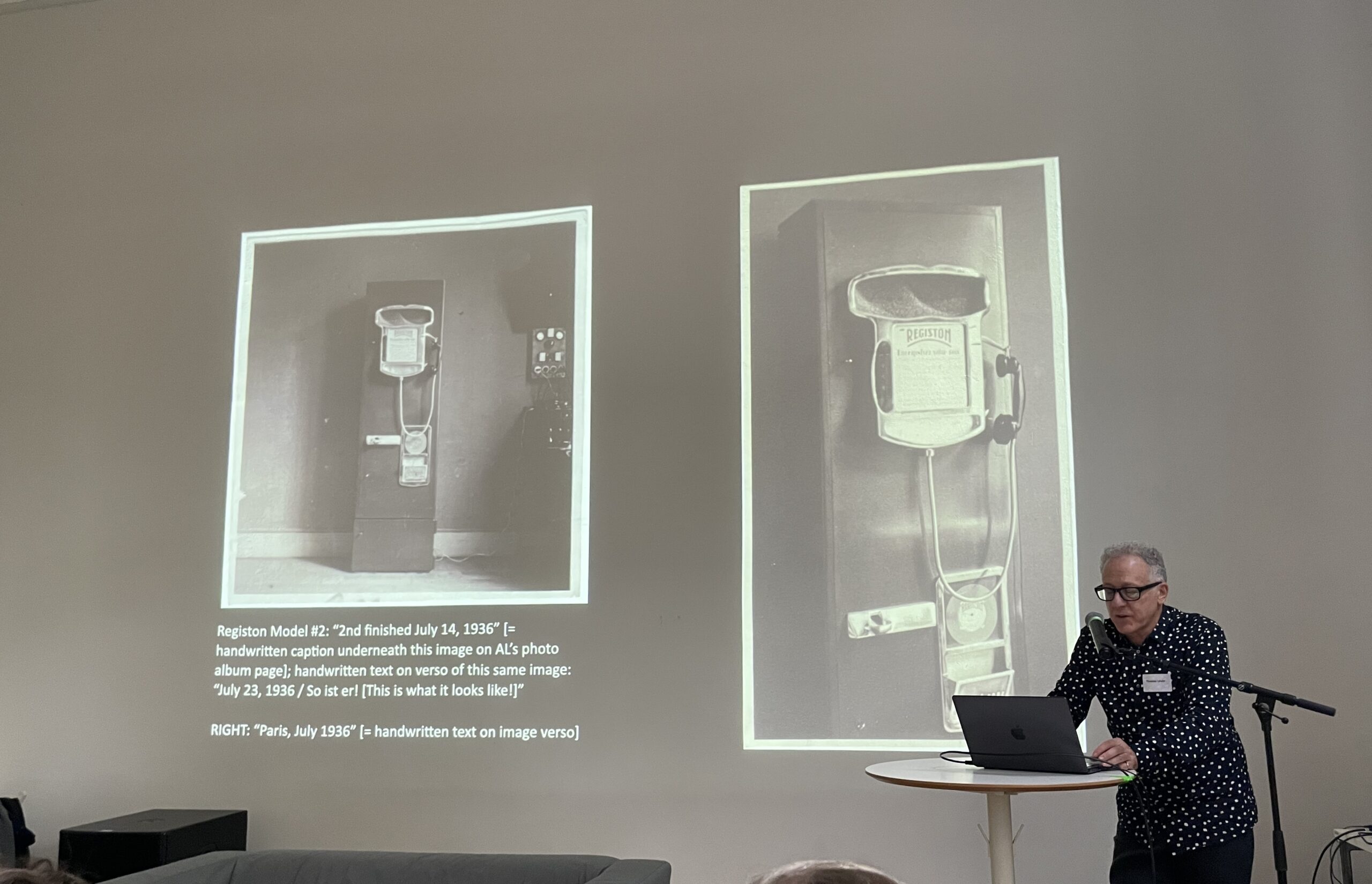
Photo: Katrin Abromeit
-

Photo: eSeL.at, Robert Puteanu
-
Photo: eSeL.at, Robert Puteanu
-

Photo: eSeL.at, Robert Puteanu
-

Photo: eSeL.at, Robert Puteanu
-
Photo: eSeL.at, Robert Puteanu
-

Photo: eSeL.at, Robert Puteanu
-

Photo: eSeL.at, Robert Puteanu
Thomas Levin
VOCAMAT, VOICE RECORDS, REGISTON: ALEXANDER LISSIANSKY AND THE PRE‑HISTORY OF THE VOICE-O-GRAPH AUTOMATIC RECORDING BOOTH
CHAIR
Eva Kapeller-Hallama
Having spent the last decade working to document the global history of gramophonic voice mail, a curiously ignored chapter of media history that one can now explore online through the Princeton Phono-Post Archive, I am frequently contacted by people wishing to donate voice mail records or tapes to my research collection. You can imagine my excitement, however, when I received an email a few years ago with the subject line: ‘My Father invented the Voice-o-Graph’! This eventually led to my gaining access to a personal Archive documenting the European pre-history of what would become the most widely-used coin-operated voice-recording technology produced by the International Mutoscope Corp of Long Island City New York. Using previously completely unknown materials from this treasure trove – including correspondence, technical drawings, photographs, internal documents, publicity materials and one-of-a-kind recordings – this lecture will tell the story of the two Jewish inventors Alexander Lissiansky (1904–1972) and Ernst Elster (1904–1942) and their role in the creation of the Registon automatic voice recording booth in Paris in the mid-1930s. This almost completely forgotten machine – only two are known to have survived – is a crucial link between various automatic public recording technologies developed in Europe and the USA around the same time for the recording of ‘spoken letters’ and the soon-to-be ubiquitous coin-op Voice-o-Graph booths that were first introduced at the Mutoscope Photomatic pavilion of the 1939 New York World’s Fair. The story of the Registon affords us new insights into the pre-history of the technical infrastructure and design culture of the individual voice recording automats that were such an important but overlooked feature of the global audio landscape from the 1930s through the 1960s.
Thomas Y. Levin is a media theorist, curator, collector and professor at Princeton University. The translator and/or editor of three books on the work of the cultural critic and film theorist Siegfried Kracauer, Levin is also the co-editor of a volume of Walter Benjamin’s media theoretical writings and of CTRL [SPACE], Rhetorics of Surveillance from Bentham to Big Brother (MIT Press 2002), the catalogue of a 2001 exhibition that he curated at the ZKM (Zentrum für Kunst und Medientechnologie) in Karlsruhe. Levin was also one of the co-curators of a series of 1989 exhibitions on the Situationist International at the Centre Pompidou, the ICA (London) and the ICA (Boston). He is currently directing a long-term research project on the media archaeology of voice mail in the context of which he has assembled the world’s first large-scale research collection of audio letters: The Princeton Phono-Post Archive.
Eva Kapeller-Hallama studied history in Vienna and St. Petersburg. She worked as a researcher and curator. For her doctoral thesis on Nazi border delousing camps in occupied Eastern Europe, she received a scholarship of the Austrian Academy of Sciences and was Junior Fellow at the International Research Center for Cultural Studies in Vienna. Since 2021 she has headed the SONIME research project ‘Sonic Memories. Audio Letters in Times of Migration and Mobility’ at the Vienna Museum of Science and Technology and since May 2024 at the Department of Media Theory at the University of Applied Arts Vienna.