
Lina Ounissi
ECHOES OF COEXISTENCE: MALOUF, MEMORY AND THE POLITICS OF VOICE IN COLONIAL CONSTANTINE
This lecture analyses malouf – a refined musical tradition rooted in Arabo-Andalusian heritage – as a bridge of collective memory between Jewish and Muslim communities in Constantine, Algeria, during the final decades of French Colonial rule (1940–1962). Based on archival recordings, oral accounts, and artistic statements, this research analyses how voice, both medium and message, carried hopes of coexistence and later, narratives of rupture in the Algerian War of Independence.
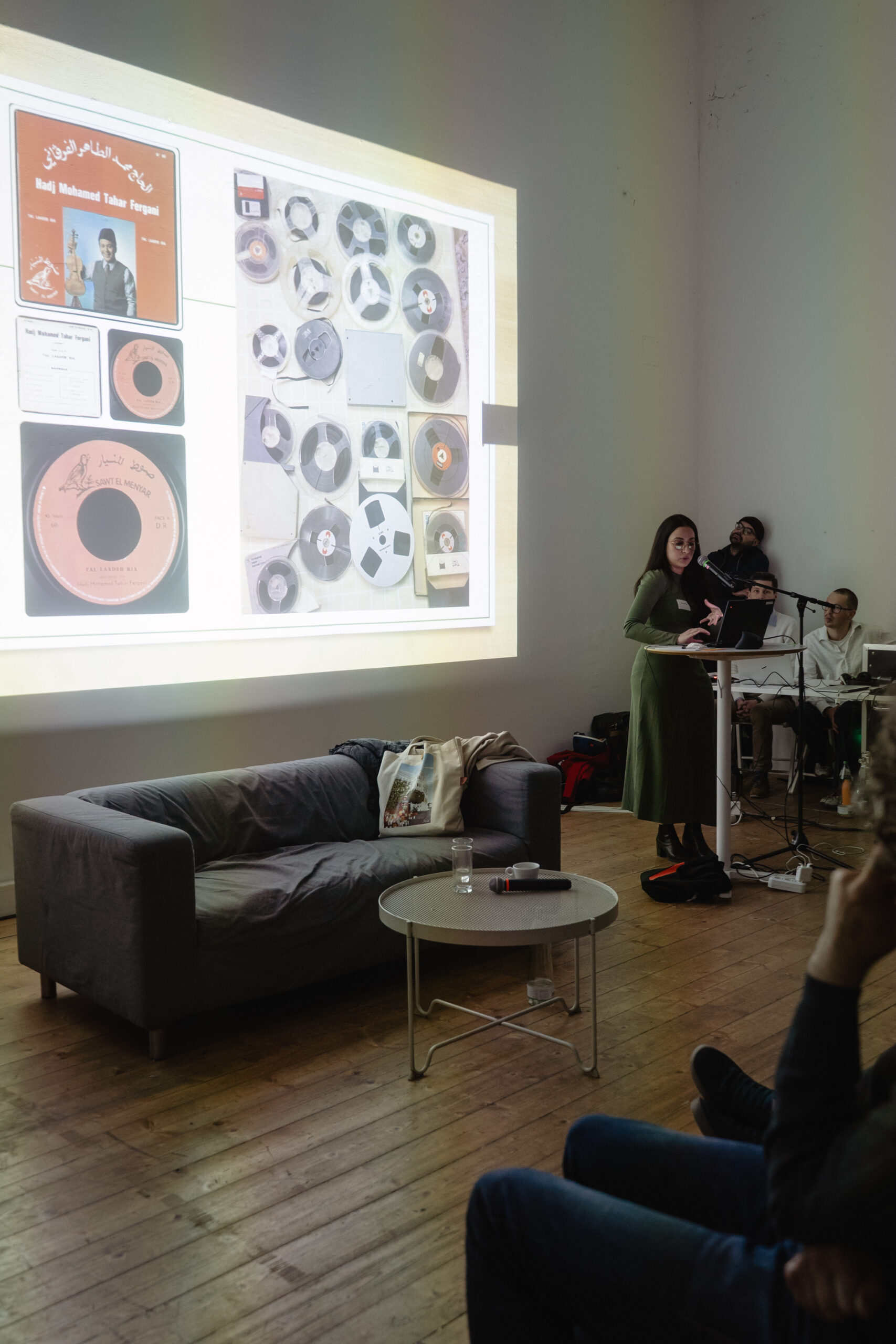
In the middle of this study is the paradox of the recorded voice: intimate yet distant, preserved yet transitory. Singers such as Cheikh Raymond and Hajj Mohamed Tahar Fergani embodied this paradox – once celebrated by all, their singing voices became markers of political allegiance, the objects of the aggressive tides of colonial repression and anti-colonial resistance. Their recordings and performances are not just cultural artefacts but contested acoustic documents of a lost future.
This presentation will marry scholarly Interpretation with selected listening extracts from historical malouf recordings and personal archives, presenting them as both artworks and political records. Through tracing the recording, circulation, and remembrance – and erasure – of these voices, it asks questions about the politics of hearing, the violence of forgetting, and the vulnerable materiality of acoustic heritage.
At last, this presentation argues that malouf’s survival as a sound form is not only evidence of the persistence of a musical tradition, but of a different account of history – one in which voice precedes and resists writing. When we re-play these voices today, what do we actually hear?
Lina Ounissi is a PhD candidate at the Department of Middle Eastern Studies, University of Basel, and research assistant in the research project ‘Futures Interrupted: Social Pluralism and Political Projects Beyond Coloniality and the Nation-State’, led by Prof. Dr. Falestin Naïli. Her current research maps the malouf of Constantine as a means of intercommunal cohabitation and cultural resistance in colonial Algeria, and she investigates how voice and sound enact memory, identity, and political imagination. Her interdisciplinarity brings together ethnomusicology, archival research, and cultural history with particular emphasis on sound heritage, Jewish-Muslim relations in North Africa, and colonial and postcolonial politics of listening. She has a Master of Middle Eastern Studies from Sciences Po Grenoble, where her Master’s thesis challenged the role of Arabic in French-Kuwaiti economic diplomacy. Prior to pursuing her doctoral research, Lina worked as a geostrategic analyst specialising in the MENA region for four years.